

28.6.11

Welcome to my garden.


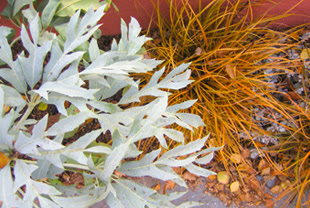
My San Francisco Bernal Heights garden is bursting at the seams this summer. The winter rains and recent spurts of warm sunny weather have brought the garden into its own.  Planting a combination of California natives, drought tolerant and low water plants from Australia, New Zealand and South Africa creates a colorful garden with year round interest.  Hardscape elements include a small deck, dry creek, sitting stones and bench. Each sitting area is tucked into the garden offering a space to enjoy the immediate surroundings or the view of the city beyond.
Utilization of bloom color, leaf texture and leaf color creates contrast and interest in the planting areas. Repeating colors of fuschia colored blooms from the old rose in the background and geranium in the foreground as well as the yellow pom poms of the interspersed Chrysocephalum have added continuity that tie the garden together.
As you exit through the gate, you enter into the gravel patio garden featuring a basalt water fountain and blooming perennials. These are the main attraction to the local yellow finch, finch & hummingbird populations.

Also incorporated in our gravel patio garden are a seating area for outdoor dining, fire pit and sitting stone.

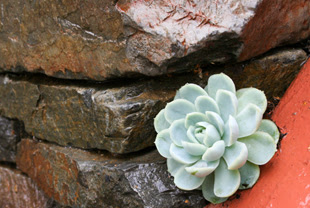
This amazing Calandrinia spectabilis is one of the most rewarding succulents in the garden. It gets no irrigation.

New Sign!


We got a new sign to put up in our gardens after we install them. Look for them around town.


This is the same garden from the last post, now in its full summer glory. It only has quarterly maintenance and still looks fab--proof that you can do drought-tolerant and low-maintenance without sacrificing color or 4-season interest.


28.1.11

Prune, Baby, Prune


Get out your ladders! Most of the leaves are off the trees now. It makes for pretty collages on the ground, and also affords the opportunity to really look at the branching structure of the trees to which they belong. Also, these deciduous trees are dormant in the winter months, so we prune Japanese maples and other trees and shrubs that need careful shaping with major cuts now, before they leaf out and their sap starts to run. As a result, we often do our major pruning of fruit trees, Japanese maple and other deciduous tree, rose, and other woody winter perennials in January.

We work annually at this scenic garden in the El Cerrito hills overlooking Wildcat Canyon. The client has many mature, productive fruit trees, including several varieties of apples, plums, a fig, lemon, lime, loquat, nectarine, and pear. We have been pruning there for about five years and at the client's request have slowly been bringing down the height of all of them to a more harvestable height.

There are several great written pruning resources that we rely on. Most are available in the local nurseries in the winter season. This one is a great staple we love: How to Prune Fruit Trees, by R. Sanford Martin. (photo courtesy of Shae at Hitchhiking to Heaven), originally published in 1944. It has general instructions and diagrams on pruning almost every fruit tree we encounter around here on a regular basis.

Apples, pears, plums, cherries, and nectarines produce their flowers and then their fruit on special structures called fruiting spurs (seen below).

There are special pruning techniques that we use to encourage spur (and thus fruit) production. Without getting into too much detail, we generally cut off all dead and injured branches, and then cut back any whip-like vegetative growth and all crossing and inward-growing branches to encourage light penetration into the canopy. Then various pruning decisions are made based on type and age of the tree, height at which it is to be maintained, number of existing fruiting spurs (if there are many, then we cut some off to keep branches from breaking under the weight of heavy production, and to encourage regeneration when existing spurs are old) and whether or not it has been consistently pruned and shaped in past years. In this garden, the multi-talented Ami prunes and snacks on a Granny Smith Apple tree.


We prune the woody perennials at the same time. Some varieties of grasses get cut to the ground, and salvias, lavenders, rock roses, loropetalums, pittosporums among others, get a hard pruning and shaping. Shrubs that are blooming now, like some camellias, azaleas, rhododendrons, and choisya ternata are pruned later after bloom.

Roses: Before


After:


Then once all the space is cleared around the plants, we take the opportunity to put down organic fertilizer like this kind, or this kind, epson salts for the roses, chicken manure for the fruit trees, and then mulch all the beds, leaving them all tucked in and ready for spring!

26.1.11

Bok bok bok


I was plant shopping at East Bay Nursery last week and stumbled across an unexpected sight in the bedding area...


Hello new friend! Keep those slugs and snails away! By the way, some of the spring flowering trees, shrubs, and perennials, plus all the bare root roses and fruit trees are starting to arrive, so go visit your local nursery today to get first pick!

17.1.11

Containers galore!

I love planting containers! I love how transformative containers can be. They can be works of art, or set the stylistic mood of a landscape or any outdoor space.


All containers above available at Design Within Reach


Everyone knows that after the holidays is a great time to shop for deep discounts. This is true for shopping at nurseries and pottery warehouses as well. I've been amassing pictures of pottery that I like for a while now, and thought I would talk a bit about how we shop for and select our pottery for installations.

When we know we are adding some containers to a design, we first talk to the client about what style they are envisioning. This is often determined by the house style, the decorating style of the client be it rustic country or modern; house and trim color, hardscape material such as brick, tile, or flagstone, and type of plant that will fill the container. It is often more of a visual impact to have simple container displays--one or several large containers rather than a jumble of lots of small ones. If doing an arrangement of several containers, we will choose the largest one first and select some smaller companion pots (if any) in complimentary shapes and colors.


There are many colors and styles that catch my eye:

colorful, modern and uniquely shaped

(both above were once available from Flora Grubb Gardens in San Francisco, CA)

Some are obvious choices for certain styles of house or garden architecture, such as hand-painted Mexican pottery to compliment the Spanish style houses found in the Bay Area, or classic urns to compliment more formal Italian and French garden styles.

(Mexican painted terracotta planter once available at East Bay Nursery in Berkeley, CA, Italian classic urn online at VandM.com)

Some examples of more rustic Indonesian and Moroccan pottery are pictured below


Or some spaces call for more contemporary shapes and materials.


(all pictured directly above and below available at AW Pottery in Oakland, CA)

I particularly love the subtle blue/green/brown color shifts in some of these Indonesian pots. They seem to compliment a variety of house styles and work with many different shapes and types of plants, whether it be something upright and formal like an olive or a Meyer lemon tree, Asian-influenced like a black bamboo or Japanese maple, or informal such as a grass or a flowering perennial.


14.1.11

Container installation

This was a quick project we did last fall, staging some containers for a house in the Hiller Highlands area of the Oakland hills that was going on the market for sale. The house was white stucco, blue trimmed Spanish-style, with terracotta tiles on the roof and brick-red accents. We decided to do one large urn in the front entrance, and flank the arched windows with two matching urn-shaped pots, and use Mediterranean plants like bougainvillea, citrus, and palms.

Before: entranceway


Before: windows


After: large urn in entranceway with palm and colorful shade underplantings


After: two matching ceramic urns with citrus and white flowering bougainvillea